


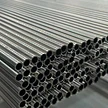
UNS S31703|1.4438|TP317L Seamless Stainless Steel Tube
Distinguished by its increased Molybdenum (3% min) and low-carbon content, our TP317L tubing offers significantly enhanced resistance to pitting and crevice corrosion compared to standard 316L grades, especially in acidic chloride environments. These tubes are indispensable for mission-critical applications in flue gas desulfurization (FGD), chemical reactors, and pulp and paper processing. Through advanced cold-drawing and precise solution annealing, XinZhe ensures every tube maintains a uniform microstructure and excellent weldability for the most aggressive industrial media.
PREN ≈ 28-30 ,higher than TP316L PREN 24-25
What Is a Seamless Stainless Steel TP317L Tube?
TP317L (UNS S31703) is the low-carbon, high-molybdenum member of the austenitic stainless steel family, with 18–20% chromium, 11–15% nickel and 3–4% molybdenum. The extra molybdenum raises the PREN above that of 316L, giving noticeably better resistance to pitting and crevice corrosion in chloride-bearing media, while the low carbon keeps welded joints free of sensitisation.
A Seamless Stainless Steel TP317L Tube (UNS S31703) is a high-alloy, low-carbon austenitic stainless steel tube specifically designed for highly corrosive and aggressive environments.
Manufactured in accordance with ASTM A213 / ASTM A312 standards, TP317L seamless tubes are produced from solid billets through hot piercing and cold drawing processes. This ensures:
The “L” (Low Carbon ≤ 0.03%) designation minimizes carbide precipitation during welding, effectively preventing intergranular corrosion in the heat-affected zone (HAZ).
With an increased Molybdenum (Mo) content of 3.0%–4.0%, TP317L offers significantly improved resistance to:
Compared to TP304L and TP316L, TP317L is the preferred material for severe chemical processing environments.
Key Features and Technical Advantages
Enhanced chromium and molybdenum content increases the Pitting Resistance Equivalent Number (PREN), making TP317L ideal for chloride-rich environments.
Low carbon composition eliminates the need for post-weld heat treatment in many applications.
Seamless manufacturing ensures:
1. Superior Pitting Resistance (High PREN Value)
Enhanced chromium and molybdenum content increases the Pitting Resistance Equivalent Number (PREN), making TP317L ideal for chloride-rich environments.
2. Excellent Intergranular Corrosion Resistance
Low carbon composition eliminates the need for post-weld heat treatment in many applications.
3. High Structural Reliability
Seamless manufacturing ensures:
4. Outstanding Chemical Resistance
Particularly suitable for:
Product Specifications and Data
To provide a comprehensive overview of this high-performance material, here are the detailed technical specifications and performance data for Stainless Steel TP317L .
The composition of Stainless Steel TP317L is carefully balanced to achieve its superior corrosion resistance and high strength.
| Cr | Ni | P | S | Mo | Mn | Si | C |
| 18.00 - 20.00 | 11.00 - 15.00 | ≤ 0.045 | ≤ 0.030 | 3.00 - 4.00 | ≤ 2.00 | ≤ 1.00 | ≤ 0.035 |
| Tensile Strength | Yield Strength | Elongation | Hardness |
|---|---|---|---|
| ≥ 515 MPa | ≥ 205 MPa | ≥ 35% | ≤ 192 HBW |
| Density | Melting Point | Thermal Expansion | Thermal Conductivity | Modulus of Elasticity | Electrical Resistivity |
|---|---|---|---|---|---|
| 8.0 g/cm³ | 1398 - 1454 °C | 16.6 µm/m·°C (20-100°C) | 16.3 W/m·K (20°C) | 193 GPa | 0.74 x 10⁻⁶ Ω·m (20°C) |
| Standard | OD(D) | Tolerance(MM) | Thickness(S) | Tolerance(MM) | Length | Tolerance | |
| MM | Common | High | MM | MM | |||
| EN 10216-5 HFD | 30≤D≤219.1(D2) | ±1.0% or ±0.5mm, whicever is the greater(取较大者) | T1, T≤4 | ±15% or ±0.6mm, whicever is the greater(取较大者) | L≤6M | +5/0 | |
| T2 | ±12.5% or ±0.4mm, whicever is the greater(取较大者) | ||||||
| 219.1≤D≤610 (D1) | ±1.5% or ±0.75mm, whicever is the greater (取较大者) | T≤0.05D | +22.5%/-15% | 6 | +10/0 | ||
| T1, 0.05D | ±15% or ±0.6mm, whicever is the greater(取较大者) | ||||||
| T2, T>0.09D | ±12.5% or ±0.4mm, whicever is the greater(取较大者) | L>12 | +by agreement/0 | ||||
| EN 10216-5 CFD | D3(D≤219.1) | ±0.75% or ±0.3mm, whicever is the greater(取较大者) | T3 | ±10% or ±0.2mm, whicever is the greater(取较大者) | |||
| D4(D≤219.1) | ±0.5% or ±0.mm, whicever is the greater(取较大者) | T4 | ±7.5% or ±0.15mm, whicever is the greater(取较大者) | ||||
| ASTM A213 HFD | D≤100 | +0.4/-0.8 | D<100,S≤2.4 | +40%/0 | HFD, all size | +5.0/0 | |
| +0.4/-1.2 | D<100,2.4 | +35%/0 | |||||
| +0.4/-1.6 | D<100,3.8 | +33%/0 | |||||
| D<100,S>4.6 | +28%/0 | ||||||
| 100 | +0.4/-1.2 | D>100, 2.4 | +35%/0 | ||||
| 200 | +0.4/-1.6 | D>100,3.8 | +33%/0 | ||||
| D>100,S>4.6 | +28%/0 | ||||||
| ASTM A213 CFD | D<25 | ±0.10 | D≤38.1 | +20%/0 | CFD, D<50.8 | +3.0/0 | |
| 25≤D≤40 | ±0.15 | ||||||
| 40 | ±0.20 | ||||||
| 50≤D<65 | ±0.25 | ||||||
| 65≤D<75 | ±0.30 | D>38.1 | +22%/0 | CFD, D≥50.8 | +5.0/0 | ||
| 75≤D≤100 | ±0.38 | ||||||
| 100 | +0.38/-0.64 | ||||||
| 200 | +0.38/-1.14 | ||||||
| ASTM A269 | D≤13 | ±0.13 | D≤13 | ±15% | D<38 | +3.2/0 | |
| 13 | ±0.13 | 13 | ±10% | ||||
| 38≤D<89 | ±0.25 | D>38 | +4.8/0 | ||||
| 89≤D<140 | ±0.38 | ||||||
| 140≤D<203 | ±0.76 | ||||||
| 203≤D<305 | ±1.01 | ||||||
| 305≤D<356 | ±1.26 | ||||||
| ASTM A270 | D<25 | ±0.13 | For weld pipe all size | ±12.5% | +3.0/0 | ||
| 25-50 | ±0.20 | ||||||
| 50-75 | ±0.25 | ||||||
| 75-100 | ±0.38 | For CD SMLS pipe D≤38.1 | +20%/0 | ||||
| 100-140 | ±0.38 | +5.0/0 | |||||
| 140-200 | ±0.75 | For CD SMLS pipe D>38.1 | +22%/0 | ||||
| 200-300 | ±1.25 | ||||||
Dimensional Standards and Tolerances
TP317L seamless tubes are supplied to the dimensional tolerances of ASTM A213 / A1016 unless a tighter project specification applies.
Custom tolerances available according to EN 10216-5 (D3/T3, D4/T4).
Common Industrial Applications
Chemical and Petrochemical Processing
- Reactors and heat exchangers
- Chloride-bearing process streams
- Acid handling equipment
Pulp and Paper Industry
- Digester and liquor lines
- Bleach plant piping
- Heat-transfer equipment
Marine and Offshore Engineering
- Seawater cooling systems
- Offshore process pipework
- Desalination plant piping
Power Generation
- Condenser and heat exchanger tubing
- FGD scrubber internals
- Water treatment piping
Quality Assurance and Manufacturing Process
Certification
All TP317L (UNS S31703) tubes are supplied to ASTM A213 / ASME SA213 and ASTM A312 / ASME SA312 with EN 10204 3.1 mill test certificates. Third-party inspection (SGS, BV, TUV, Lloyd's), PMI reports and full heat-number traceability can be provided on request.
Non-Destructive Testing (NDT)
Hydrostatic or eddy-current testing is performed on 100% of tubes. Ultrasonic testing (UT) and dye-penetrant inspection (PT) are available for critical service, with records retained for each production lot.
Material Verification
Positive Material Identification (PMI) and spectrometric analysis confirm that the chemical composition matches the ordered grade and that the ferrite/austenite balance is within the specified range.
Mechanical Testing
Tensile, yield, elongation and hardness tests are carried out per heat. Impact testing can be supplied at the project design temperature for subsea and low-temperature service.
Dimensional Inspection
Outside diameter, wall thickness, ovality and straightness are measured against ASTM A1016 / A1016M or ASTM A789 tolerances. Length, square-cut ends and end-finish conditions are verified before packing.
TP317L vs TP316L / TP317 – Technical Comparison
TP317L sits between TP316L and TP317. The comparison turns on carbon content and molybdenum level.
Chemical Composition
- TP316L: 2–3% Mo, carbon 0.030% maximum
- TP317L: 3–4% Mo, carbon 0.030% maximum
- TP317: 3–4% Mo, carbon 0.08% maximum
Corrosion Resistance
The extra molybdenum in both 317 grades raises the PREN above that of TP316L, giving better resistance to pitting and crevice corrosion in chloride-bearing media and improved performance in sulphur-bearing and acidic process streams.
Weldability
TP317L's low carbon keeps the heat-affected zone free of sensitisation, which is why the L grade is preferred for welded construction. TP317 with its higher carbon can develop carbide precipitation after welding unless it is solution annealed.
Selection Guide
- Choose TP317L for welded equipment in chloride-bearing or acidic service, including pulp and paper and chemical plant
- Choose TP317 where higher carbon is acceptable and the component is not welded or can be annealed
- Choose TP316L where the additional molybdenum is not needed
Frequently Asked Questions
What is TP317L tube?
TP317L (UNS S31703) is the low-carbon, high-molybdenum member of the austenitic stainless steel family, with 18–20% chromium, 11–15% nickel and 3–4% molybdenum. The extra molybdenum raises its PREN above that of TP316L.
What is the difference between TP317L and TP316L?
The key difference is molybdenum content: TP317L contains 3–4% against 2–3% in TP316L. That raises the PREN and gives noticeably better resistance to pitting and crevice corrosion in chloride-bearing media, while both share the low carbon that keeps welded joints free of sensitisation.
What standard covers TP317L tube?
TP317L seamless tube is supplied to ASTM A213 / ASME SA213 and ASTM A312 / ASME SA312, with dimensional tolerances per ASTM A1016 / A1016M.
What is TP317L tube used for?
TP317L is used for chemical and petrochemical reactors and heat exchangers, pulp and paper digester and bleach plant equipment, marine and offshore seawater systems and power plant condenser tubing.
Ready to Request a Quotation?
Send your Seamless Stainless Steel TP317L Tube enquiry with grade, application, size (OD and wall thickness or schedule), quantity, length, end finish and inspection requirements. Our technical team will confirm availability, testing scope and lead time.
 UNS S31700|1.4449|TP317 Seamless Stainless Steel Tube
 UNS S31703|1.4438|TP317L Seamless Stainless Steel Tube
 UNS S34709|1.4912|TP347H Seamless Stainless Steel Tube
 UNS S34700|1.4550|TP347 Seamless Stainless Steel Tube
 UNS S32109|1.4878|TP321H Seamless Stainless Steel Tube
 UNS S32100|1.4541|TP321 Seamless Stainless Steel Tube
 UNS N08904|1.4539|TP904L Seamless Stainless Steel Tube
 UNS N08031|1.4562|Alloy 31 Seamless Tube
 UNS S30815|1.4835|253MA Seamless Stainless Steel Tube
 UNS S31254|1.4547|254SMO Seamless Stainless Steel Tube